
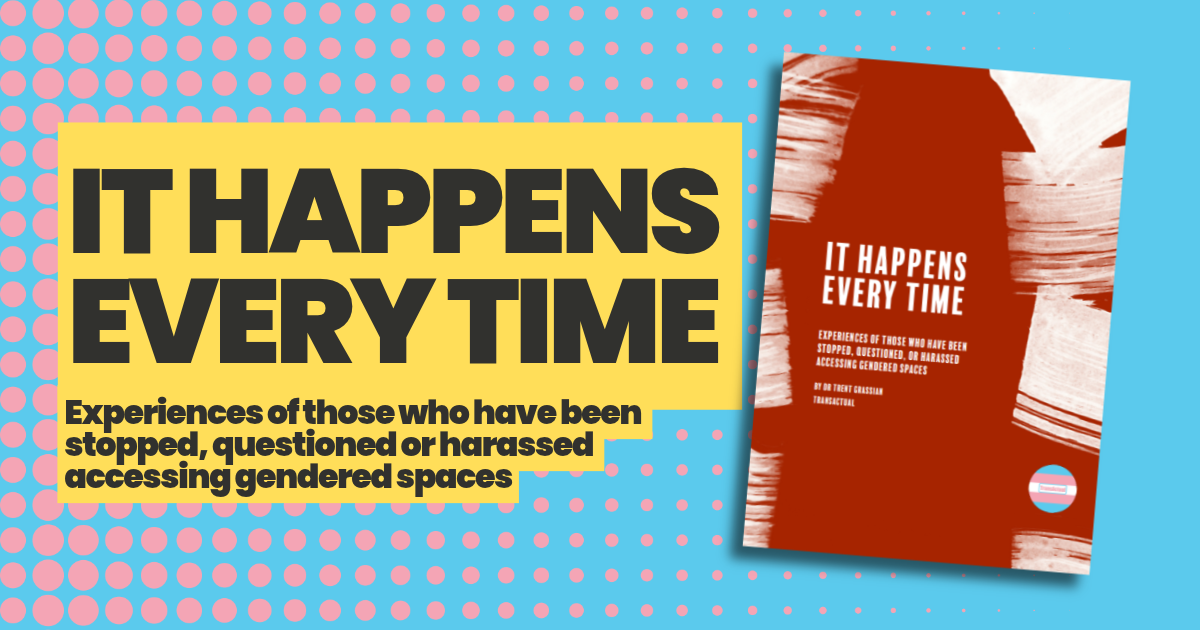
Violence and harassment against trans people is nothing new in the UK. But since the 16 April 2025 Supreme Court judgment on the definition of sex in the Equality Act, and the subsequent publication of the EHRC’s interim guidance and updated Code of Practice for Services, Public Functions, and Associations, trans people report growing levels of harassment, discrimination, and segregation. The concomitant impacts have been widely felt by all those who do not conform to societal gender norms.
To monitor these trends, TransActual collected the testimonies of people who have been stopped, questioned, or harassed when using (or trying to use) gendered spaces. Between May 2025 and August 2026, we collected 338 stories, 260 of which are from the period following the Supreme Court judgment.
We heard from people who had been sexually assaulted after trying to access public toilets, who had been subjected to physical violence and unwanted contact at their local gym, and who experienced verbal harassment, threats, and intimidation simply for existing in a way that doesn’t wholly conform to gendered norms in the UK.
Of the 260 incidents reported to us following the Supreme Court judgment on 16 April 2025:
- Nearly one in ten (9%, 22) involved physical or sexual violence;
- One in four (25%, 64) involved verbal harassment, threat, or intimidation;
- Nearly one in three (31%, 81) of those reporting an incident were aggressively misgendered, often involving use of derogatory language and/or attempts to publicly humiliate someone;
- Members of the public (including work colleagues) perpetrated more than one in four incidents (28%, 72), with many cases involving those claiming they are trying to uphold “the law” as they openly harass and assault those whose gender or biological history they are questioning;
- Bouncers and security were involved in 10% (25) of incidents, with individuals reporting having been expelled from venues simply for trying to use the bathroom;
- 18% (47) of incidents had witnesses, who often stood by and did nothing to help;
- One in five incidents (20%, 51) involved someone being told they can only use the disabled bathroom.
- More than one in six incidents (17%, 45) involved someone being stopped while attempting to comply with the EHRC guidelines, e.g. by using the toilet intended for their sex assigned at birth;
- One in ten (10%, 26) affected individuals self-identified as cis (not trans), including women who have facial hair due to polycystic ovary syndrome (PCOS), women with short hair, and men with long hair and/or wearing makeup;
- Trans women were the most likely to be targeted (43%, 113), followed by trans men (20%, 53), and nonbinary people (14%, 36); and
- Nearly one in four incidents (24%, 63) happened at work, with many saying they now have no toilets they can use or are having to walk 15 minutes or more to access their ‘designated’ toilets.
These findings are deeply disturbing, yet reflective of the reality that, even before these new guidelines, 62-73% of trans people had experienced harassment or violence, while being more than four times more likely than non-trans people to be victims of violent crime. However, our findings demonstrate that it is not just trans people who are being affected by the new guidelines.
It is clear that the Supreme Court Judgment and EHRC guidance have empowered staff to scrutinise service users’ and staff members’ assigned birth sex and current anatomy. This widespread gender policing has, in turn, encouraged gender vigilantes to mete out violence and harassment against anyone they suspect of being trans.